totalitarizam.oglas.app HR The verdict

00 Comparative history · Long read

Two dictators,
one century.

Adolf Hitler and Joseph Stalin were born in 1889, came of age in the First World War and built their power on the ruins of empire. Between them they defined the darkest decades of the twentieth century: one through a war of racial conquest and genocide, the other through class terror, famine and the Gulag. This comparison sets the two regimes side by side across eight dimensions — power, ideology, economy, terror, targets, propaganda, war and the death toll — and asks what their similarities and differences can and cannot tell us about totalitarian rule.

This is an analytical comparison, not a moral equivalence. Both regimes were criminal: Nazi Germany committed genocide and a war of annihilation; the Soviet Union murdered, starved and deported millions. The aim is to understand how totalitarian power works — to recognise its mechanisms — and not to rank the dead or to excuse either regime in any way.

  • 13 min read
  • 26 sources
  • 8 dimensions

01 Overview

At a glance

Eight dimensions, two regimes: what the comparison shares, where it diverges, and why the tags mark degrees of similarity rather than scores.

The table below condenses the comparison into eight dimensions and three tags. Shared means the two regimes solved the same problem of power in structurally similar ways; partly shared means the mechanism resembles the other while the purpose, scale or target differed; different means the projects themselves diverged. The tags describe the logic of rule, not its outcome (Overy 2004).

Similarity here is a matter of degree, and the degrees are uneven. Both states abolished competitive politics, both built a secret police and a camp system, and both organised a leader cult; neither tolerated an independent press or an autonomous court (Arendt 1951). Yet behind the common machinery stood incompatible intellectual projects: one classified people by race, the other by class, and both classifications licensed violence against whole categories of human beings.

The warning matters more than the table. A shared mechanism does not make the crimes equivalent: the Holocaust was an industrial genocide with no equivalent in kind under Stalin, while Stalin's famine, deportations and mass executions were crimes of a different construction (Gellately 2007). Reading a shared tag as a moral score is the error this page is designed to prevent.

Shared Partly shared Different
Eight dimensions compared
DimensionHitler’s regimeStalin’s regime
Rise to power Partly shared Electoral dead end, elite bargain, emergency decrees Party machine, appointment power, factional victory
Ideology Different Racial hierarchy, antisemitism, Lebensraum in the East Class struggle, vanguard party, socialism in one country
Economy and modernisation Partly shared Rearmament, autarky, private property under state direction Collectivisation, five-year plans, state ownership of industry
Terror and the police state Shared SS and Gestapo, protective custody, camps from 1933 Cheka to NKVD, Article 58, show trials, the Gulag
Who was targeted Different Jews, Roma, disabled people, Slavs, prisoners of war Kulaks, class enemies, Old Bolsheviks, deported nations
Propaganda, cult and youth Shared Goebbels’ ministry, rallies, film, Hitler Youth Pravda, socialist realism, Stakhanovism, Komsomol
War and foreign policy Partly shared Expansion in Europe, war of annihilation in the East Pact with Hitler, Winter War, then the Eastern Front
The death toll Different Genocide and a deliberate war of annihilation Famine, executions, camp deaths, deportations

Sources: Overy 2004, Arendt 1951, Gellately 2007.

02 Chronology

Two lives, one century

Two lives run in parallel columns, from the same birth year to opposite ends of the Second World War — with the same years in both editions.

Adolf Hitler and Joseph Stalin were both born in 1889, and both were formed politically by the First World War and the collapse of the Habsburg, Romanov and Ottoman empires (Kershaw 1998–2000; Kotkin 2014–17). The chronology below places the two careers side by side so that the parallel timing is visible before the differences are explained.

The years coincide more often than the content does. 1933 gave Hitler the chancellorship and the Enabling Act; Stalin had taken the party machine eleven years earlier and used the 1930s for collectivisation and the Great Terror. Both men were in power when the Molotov–Ribbentrop Pact was signed in 1939, and both were still in power when it was broken in 1941 (Bullock 1991; Kershaw 1998–2000; Kotkin 2014–17).

A shared calendar is not a shared history. The timeline is a reading aid, not an argument: it shows that two totalitarian systems matured in the same European crisis, not that they did the same things. The sections that follow test each parallel against the evidence.

Adolf Hitler · 1889–1945

  1. Born on 20 April in Braunau am Inn, then in Austria-Hungary.

  2. Enlists in the Bavarian army after the war begins; serves on the Western Front.

  3. Leads the Beer Hall Putsch in Munich; it fails and he is imprisoned.

  4. Appointed Chancellor on 30 January; the Enabling Act follows on 23 March.

  5. Becomes Führer after Hindenburg dies; the Night of the Long Knives purges the SA.

  6. Anschluss with Austria in March; the Munich Agreement cedes the Sudetenland in September.

  7. Signs the Molotov–Ribbentrop Pact; Germany invades Poland on 1 September.

  8. Operation Barbarossa invades the Soviet Union on 22 June.

  9. Defeat in Berlin; he commits suicide on 30 April.

Joseph Stalin · 1889–1953

  1. Born on 18 December in Gori, then in the Russian Empire.

  2. The October Revolution brings the Bolsheviks to power; he is in the leadership.

  3. Becomes General Secretary of the Communist Party in April.

  4. Collectivisation and the First Five-Year Plan begin; the kulaks are targeted.

  5. Famine across the Soviet Union; millions die, most of them in Ukraine.

  6. Show trials and the Great Terror: mass arrests, executions and the Gulag expand.

  7. Signs the pact with Hitler; the USSR invades Poland and attacks Finland.

  8. Victory over Germany; Soviet forces occupy Eastern Europe.

  9. Dies in Moscow on 5 March.

Sources: Kershaw 1998–2000, Kotkin 2014–17, Bullock 1991.

03 Dimension 1 / 8

Rise to power

Neither dictator came to power through a free majority: one was handed the chancellorship by an elite bargain, the other was raised by a party machine.

Hitler's route ran through an electoral dead end. The Nazi Party won 2.6 per cent of the vote in 1928 and 37.3 per cent in July 1932, but it never obtained an absolute majority in a free election; its 43.9 per cent in March 1933 was won under terror (Kershaw 1998–2000; Evans 2003). On 30 January 1933 President Hindenburg appointed Hitler Chancellor as part of a conservative bargain. The Reichstag fire of 27–28 February, the Fire Decree and the Enabling Act of 23 March turned the appointment into a dictatorship, and the remaining parties were banned by 14 July 1933 (Evans 2003). After Hindenburg died on 2 August 1934, Hitler combined the presidency with the chancellorship and took the title of Führer; the Night of the Long Knives (30 June – 2 July 1934, at least 85 dead by the official count) had already purged the SA leadership (Kershaw 1998–2000).

Stalin's route ran through the party. He became General Secretary in April 1922, a post that let him place loyalists across the apparatus, and used that position to defeat Trotsky, who was expelled in 1927 and deported in 1929 (Kotkin 2014–17; Conquest 1990). Stalin never faced a competitive national election. The First Five-Year Plan began in 1928, and in December 1929 the regime announced the liquidation of the kulaks as a class (Kotkin 2014–17; Conquest 1986).

The mechanisms differ, but the pattern recurs. Both men used paramilitary violence, destroyed or absorbed rival organisations, and treated emergency powers as the normal instrument of rule. In Germany the sequence was electoral pressure, an elite bargain, decree and then purge; in the Soviet Union it was party appointment, factional victory and then a war on the peasantry. Neither regime asked the electorate for a mandate once it held the state.

Adolf Hitler

  • Peak free-election support: 37.3 per cent in July 1932; never an absolute majority.
  • Appointed Chancellor by Hindenburg on 30 January 1933, not elected to power.
  • The Enabling Act and the party ban of July 1933 ended parliamentary government.

Joseph Stalin

  • General Secretary from April 1922; appointment power built the faction that beat Trotsky.
  • Never faced a competitive national election at any point in his rule.
  • From December 1929: liquidation of the kulaks as a class and forced collectivisation.

Sources: Kershaw 1998–2000, Evans 2003, Kotkin 2014–17, Conquest 1990, Conquest 1986.

04 Dimension 2 / 8

Ideology

Two doctrines, two laws of history: race and empire in one case, class and party in the other — each convinced it had found the engine of history.

Nazi ideology was set out before power, above all in Mein Kampf (1925–26): a racial hierarchy with the Jews cast as a biological enemy, Lebensraum in the East, the Führerprinzip and the Volksgemeinschaft (Kershaw 1998–2000; Evans 2003). It promised a purified national community and a continental empire, and it treated politics as a racial struggle to be won.

Stalinist ideology was Marxist-Leninist: class struggle, the vanguard party, and from 1925 'socialism in one country' (Kotkin 2014–17). It promised a classless industrial society and treated politics as the conscious direction of a historical process. Where Nazism classified people by descent, Stalinism classified them by social position — and both classifications could be applied to whole populations at once.

The deeper family resemblance lies in the structure of the belief. Both doctrines claimed to explain all of history and to license any means in its service (Arendt 1951). Both treated entire categories of people as obstacles to a mission, and both therefore made the removal of those categories a political goal in itself. Totalitarian ideology is not merely a programme of government; it is a claim to know the direction of history, and that claim is what turns policy into persecution.

Adolf Hitler

  • Race as the engine of history; Jews cast as a biological enemy to be removed.
  • Lebensraum: conquest of the East as a demographic and colonial project.
  • Führerprinzip and Volksgemeinschaft: one will, one racially purified community.

Joseph Stalin

  • Class struggle as the engine of history; the party as its conscious vanguard.
  • Socialism in one country (1925): industrialise and survive in a hostile world.
  • Class enemies defined socially and politically, not by descent.

Sources: Kershaw 1998–2000, Evans 2003, Kotkin 2014–17, Arendt 1951.

05 Dimension 3 / 8

Economy and modernisation

Both regimes put the economy at the service of the state's project; they disagreed about who should own it and what it was for.

Stalin's economy was built by command. From 1928 the five-year plans assigned priority to heavy industry and armaments, and agriculture was forced into collective farms (Kotkin 2014–17; Fitzpatrick 1999). About 1.8 million peasants were deported as 'kulaks' between 1930 and 1933, and the disruption contributed to a famine that killed 3.5–5 million people in 1932–33, most of them in Ukraine (Conquest 1986; Applebaum 2017). The Gulag supplied forced labour for construction and industry (Applebaum 2003).

Hitler's economy kept private property but directed it. Rearmament, autarky and the Four Year Plan of 1936, run by Göring, subordinated markets to the state's preparation for war (Overy 2004). Plunder of occupied Europe and the labour of foreign workers and prisoners of war became central: by 1944 some 8 million foreign workers and POWs were in the German war economy (Overy 2004). Ownership was private; direction was not.

The comparison is therefore not 'state versus market'. Both systems mobilised labour by coercion, both put guns before butter, and both measured success in output and military capacity rather than in consumption. The difference is that Stalin's state owned the means of production and planned them directly, while Hitler's state left the owners in place and commanded their output. In both cases the human cost was treated as an input.

Adolf Hitler

  • Private ownership retained; investment directed to rearmament and autarky.
  • Four Year Plan (1936), under Göring, coordinated the war economy.
  • By 1944, some 8 million foreign workers and POWs in the German economy.

Joseph Stalin

  • Five-year plans from 1928; priority to heavy industry and armaments.
  • About 1.8 million peasants deported as kulaks, 1930–33.
  • Famine of 1932–33 killed 3.5–5 million, most in Ukraine.

Sources: Overy 2004, Kotkin 2014–17, Fitzpatrick 1999, Conquest 1986, Applebaum 2017, Applebaum 2003.

06 Dimension 4 / 8

Terror and the police state

Two police states built on one premise: the regime's enemy is whoever it says, and the law is an instrument of the party.

The Nazi police state was built quickly. Dachau opened on 22 March 1933, and 'protective custody' without trial became routine; the Gestapo and the SS Security Service were fused under Himmler, and the People's Court, established in 1934, replaced ordinary due process with political justice (Evans 2003; Shirer 1960). After 1941 the apparatus of camps and mobile killing units extended into occupied Europe, where the extermination camps — Chełmno, Bełżec, Sobibór, Treblinka, Auschwitz-Birkenau and Majdanek — carried out the genocide (USHMM). Auschwitz-Birkenau alone killed about 1.1 million people, of whom about one million were Jews (USHMM).

The Soviet police state had a longer pedigree. The Cheka became the NKVD, and Article 58 of the criminal code turned political dissent into a criminal category; show trials and the mass operations of 1937–38 produced about 1.5 million arrests and some 680,000 executions in NKVD records (Getty, Rittersporn & Zemskov 1993; Conquest 1990). The Gulag became a permanent institution: up to about 2.5 million people were held in the camps in the early 1950s, and some 18 million passed through the system between 1929 and 1953 (Applebaum 2003). Its scale was first forced into public view by survivors' testimony (Solzhenitsyn 1973–76). Katyn, in April–May 1940, added about 22,000 murdered Polish officers to the record (Snyder 2010).

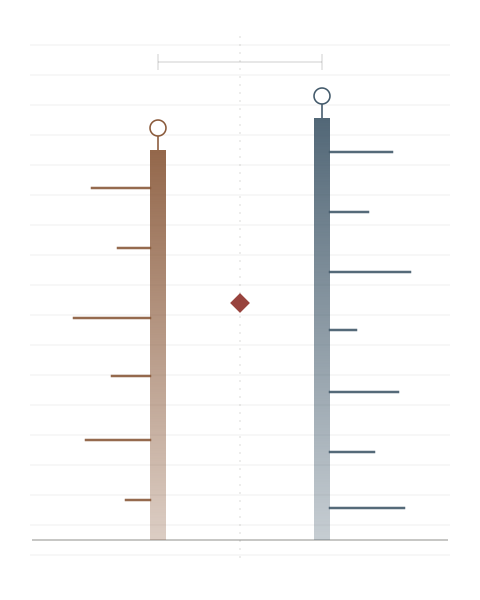
The shared element is not the identity of the victims but the position of violence in government. In both states the police answered to the party rather than to law, confession was obtained by torture, the camps were permanent rather than exceptional, and the category of 'enemy' could be widened by decree. The Soviet regime also deported whole nations: the Crimean Tatars (about 191,000 in 1944), the Chechens and Ingush (about 400,000–500,000 in 1944) and the Volga Germans (about 400,000 in 1941) were moved by force under Stalin (Naimark 2010). What differs is the selection principle — race in one case, class and political loyalty in the other — and that difference is the subject of the next section.
Adolf Hitler

  • Dachau opened 22 March 1933; protective custody without trial became routine.
  • SS and Gestapo fused under Himmler; the People's Court (1934) ended due process.
  • Six extermination camps in occupied Poland; Auschwitz-Birkenau killed about 1.1 million.

Joseph Stalin

  • Cheka to NKVD; Article 58 criminalised political dissent.
  • 1937–38: about 1.5 million arrests and some 680,000 documented executions.
  • About 18 million people passed through the Gulag between 1929 and 1953.

Sources: Evans 2003, Shirer 1960, Getty, Rittersporn & Zemskov 1993, Conquest 1990, Applebaum 2003, Solzhenitsyn 1973–76, Naimark 2010, Snyder 2010, USHMM.

07 Dimension 5 / 8

Who was targeted

Both regimes sorted people into categories and acted on the category; the categories themselves are where the decisive difference lies.

Nazi targeting was racial first. The Holocaust murdered about 6 million Jews, with estimates of 5.7–6.0 million (USHMM; Yad Vashem; Hilberg 2003). It was a genocide: a deliberate, organised attempt to destroy a people (Browning 2004; Snyder 2015; Gerlach 2016). Roma and Sinti were killed in the same system, with estimates of 220,000–500,000 victims; the 'euthanasia' programme killed some 200,000–250,000 disabled people; roughly 5,000–15,000 homosexuals were imprisoned in camps (USHMM).

The occupation policies widened the category of victim. Soviet prisoners of war died in German captivity in numbers of 3.0–3.3 million out of about 5.7 million captured, and millions of non-Jewish Soviet civilians were killed in the war of annihilation (USHMM; Snyder 2010).

Soviet targeting was class-based and political, then national. About 1.8 million peasants were deported as kulaks in 1930–33 (Conquest 1986). Old Bolsheviks and 'class enemies' were destroyed in the purges, and whole nations — Crimean Tatars, Chechens, Ingush, Volga Germans, Koreans, Poles and others — were deported by force (Naimark 2010). Hundreds of thousands of returning Soviet prisoners of war passed through filtration and the Gulag (Applebaum 2003). The Holocaust has no equivalent in kind under Stalin; the Soviet national deportations are treated by some scholars as genocide, and that argument is contested (Naimark 2010; Snyder 2010).

Adolf Hitler

  • Jews: the Holocaust, about 6 million murdered (5.7–6.0 million).
  • Roma and Sinti 220,000–500,000; disabled people 200,000–250,000 killed.
  • Soviet POWs: 3.0–3.3 million dead of about 5.7 million captured.

Joseph Stalin

  • Kulaks: about 1.8 million deported, 1930–33.
  • Whole nations deported: Crimean Tatars, Chechens, Ingush, Volga Germans.
  • Returning POWs: hundreds of thousands through filtration and the Gulag.

Sources: USHMM, Yad Vashem, Hilberg 2003, Gerlach 2016, Browning 2004, Naimark 2010, Snyder 2010, Snyder 2015, Applebaum 2003, Conquest 1986.

08 Dimension 6 / 8

Propaganda, cult and youth

Both regimes treated information as territory to be captured, and both built a leader cult around a man who claimed to embody the nation.

The Nazi regime organised persuasion as a ministry. Goebbels' Ministry of Public Enlightenment and Propaganda was created on 13 March 1933 and controlled press, film, radio and public ceremony (Evans 2003). Book burning on 10 May 1933 announced the new canon; the Nuremberg rallies and Leni Riefenstahl's Triumph of the Will (1935) turned politics into spectacle (Shirer 1960; Overy 2004). The Hitler Youth enrolled millions of members by 1939, binding the next generation to the movement (Overy 2004).

The Soviet regime censored and staged in parallel. Glavlit controlled print, and socialist realism was adopted in 1934 as the official aesthetic; the Stakhanovite campaign from 1935 turned labour productivity into a public spectacle (Fitzpatrick 1999; Kotkin 2014–17). Stalin's cult gave him titles such as 'Father of Nations' and 'great helmsman', and the Komsomol and Young Pioneers channelled youth into the party-state (Montefiore 2003; Fitzpatrick 1999).

The resemblance is structural. Both regimes claimed a monopoly of truth, both made the leader the embodiment of the collective will, and both organised youth as a transmission belt for the ideology. Both also understood that the point of propaganda is not persuasion alone but the elimination of a public sphere in which other claims could be heard. The content of the message was different; the architecture of the monopoly was not.

Adolf Hitler

  • Goebbels' ministry, created 13 March 1933, controlled press, film and radio.
  • Book burning 10 May 1933; Nuremberg rallies filmed in Triumph of the Will (1935).
  • Hitler Youth: millions of members by 1939.

Joseph Stalin

  • Glavlit censorship; socialist realism adopted as official style in 1934.
  • Stakhanovite campaign from 1935 made productivity a spectacle.
  • Komsomol and Young Pioneers mobilised the young; the cult made Stalin the 'great helmsman'.

Sources: Evans 2003, Shirer 1960, Overy 2004, Fitzpatrick 1999, Kotkin 2014–17, Montefiore 2003.

09 Dimension 7 / 8

War and foreign policy

Both states were aggressors before 1941; their alliance divided Eastern Europe, and their war destroyed it.

The two regimes began as partners. The Molotov–Ribbentrop Pact of 23 August 1939 contained a secret protocol dividing Eastern Europe; Germany invaded Poland on 1 September and the Soviet Union on 17 September (Snyder 2010; Overy 2004). The Soviet Union then attacked Finland in the Winter War of 30 November 1939 – 13 March 1940 and occupied the Baltic states in June 1940 (Overy 2004).

The alliance broke in 1941. Operation Barbarossa, launched on 22 June 1941, was a war of conquest, starvation and extermination in which the Hunger Plan deliberately targeted Soviet civilians and prisoners of war (Kershaw 1998–2000; Overy 2004; Browning 2004; Gerlach 2016; Snyder 2010). Hitler declared war on the United States on 11 December 1941 (Shirer 1960). The Soviet Union lost about 26–27 million citizens in the war (Overy 2004).

Victory did not end the pattern. Soviet forces occupied Eastern Europe from 1944–45 onward and installed satellite regimes (Snyder 2010; Applebaum 2003). Hitler's war ended in his suicide in Berlin on 30 April 1945 (Kershaw 1998–2000); Stalin's state survived him and expanded its sphere. For the comparison, the crucial point is that both were aggressors before they were victims: the pact of 1939, the invasion of Poland and the Winter War are not footnotes to 1941 but part of the same record.

Adolf Hitler

  • Invaded Poland on 1 September 1939; the war of annihilation followed in the East.
  • Barbarossa, 22 June 1941: conquest, starvation and extermination.
  • Declared war on the United States on 11 December 1941.

Joseph Stalin

  • Molotov–Ribbentrop Pact, 23 August 1939, with a secret protocol dividing Eastern Europe.
  • Invaded Poland on 17 September 1939; attacked Finland in the Winter War.
  • Occupied the Baltic states in June 1940; held Eastern Europe after 1945.

Sources: Snyder 2010, Overy 2004, Kershaw 1998–2000, Shirer 1960, Gerlach 2016, Applebaum 2003, Browning 2004.

10 Dimension 8 / 8

The death toll

Six ranges, not one total: the figures below measure different things, overlap with one another and are not a scoreboard.

The numbers in this section are ranges because the evidence is a set of overlapping records, not a single ledger. For Nazi Germany the core figure is the genocide of the Jews: 5.7 to 6.0 million victims, documented across the Holocaust literature (USHMM; Yad Vashem; Hilberg 2003). The broader category of all civilian victims of the Nazi regime is estimated at 11 to 12 million, which includes the Jewish dead (USHMM; Gerlach 2016).

For the Soviet Union the chart separates three different kinds of evidence. The 1937–38 mass operations are documented in NKVD records: about 1.5 million arrests and roughly 680,000 to 750,000 executions (Getty, Rittersporn & Zemskov 1993; Conquest 1990). Deaths inside the detention system are an administrative estimate of 1.0 to 2.0 million (Applebaum 2003). The 1932–33 famine killed 3.5 to 5.0 million people in the USSR, most of them in Ukraine (Applebaum 2017; Conquest 1986).

Adding those rows together would be an error, because the categories overlap: Jews are counted inside the all-civilian row, and executions, camp deaths and famine deaths are counted inside the 6 to 9 million estimate of Stalin-era excess deaths (Snyder 2010; Applebaum 2003; Wheatcroft 1996). 'Excess deaths' is a demographic estimate, 'documented executions' is a police statistic and 'camp deaths' is an administrative figure; they measure different things. Higher pre-archival estimates (Conquest, Werth) and lower archival ones (Getty, Wheatcroft) bracket the debate (Conquest 1990; Werth 1999; Wheatcroft 1996). A death toll is not a moral score, and comparing totals does not rank the crimes.

Holocaust: Jewish victims

5.7–6.0 million

Nazi regime: all civilian victims

11–12 million

Stalin-era executions, 1937–38 (documented)

680,000–750,000

Soviet detention-system deaths

1.0–2.0 million

Soviet famine, 1932–33

3.5–5.0 million

Stalin-era excess deaths, total

6–9 million

These bars are not additive. The Jewish victims are included in the Nazi all-civilian row; executions, camp deaths and famine deaths are included in the Stalin-era excess-deaths row; and the rows use incompatible methods (demographic excess, police statistics, administrative counts). Estimates remain contested between pre-archival and archival-based scholarship, so no single total is presented as settled.

Sources: USHMM, Yad Vashem, Hilberg 2003, Gerlach 2016, Getty, Rittersporn & Zemskov 1993, Applebaum 2003, Applebaum 2017, Conquest 1986, Conquest 1990, Snyder 2010, Wheatcroft 1996, Werth 1999.

11 Conclusion

The verdict

The comparison has a conclusion, and it is not a ranking.

Taken together, the eight dimensions describe two regimes that solved the problem of power in recognisably similar ways. Both abolished competitive politics and the rule of law, both built a secret police and a system of camps, both monopolised truth and organised the young, and both claimed that history licensed anything done in its name (Arendt 1951; Overy 2004; Gellately 2007). That shared architecture is why 'totalitarian' remains a useful analytical word — and why the comparison is worth making at all.

The similarity of mechanism does not collapse the difference of purpose. The Nazi project was racial and exterminatory: it aimed at the biological remaking of Europe and at a war of annihilation in the East (Snyder 2010; Naimark 2010). The Stalinist project was class-transformative and imperial: collectivisation, forced industrialisation, class terror and a bloc of satellite states (Bullock 1991; Overy 2004). The Holocaust was a genocide without an equivalent in kind under Stalin, and Stalin's crimes had no equivalent in kind under Hitler. A scalar ranking of the two would require a common unit that does not exist. The comparison is for recognising the mechanism of totalitarian power, not for grading its victims (Arendt 1951; Snyder 2010).

What they shared

A single party fused with the state; ideology as the licence to rule; terror as ordinary administration; a secret police; camps; a leader cult; a monopoly of truth; mass mobilisation; contempt for the rule of law (Arendt 1951; Overy 2004; Gellately 2007).

Where they diverged

One project was racial and exterminatory, aimed at biological remaking, Lebensraum and a war of annihilation; the other was class-transformative and imperial, aimed at collectivisation, industrialisation and a bloc of satellite states (Snyder 2010; Naimark 2010; Bullock 1991).

Conclusion

Both regimes were criminal, and neither excuses the other. Comparing their mechanisms is how a society learns to recognise the pattern early; it is not a way of ranking the dead, and it implies no moral equivalence (Arendt 1951; Overy 2004; Snyder 2010).

Sources: Arendt 1951, Overy 2004, Gellately 2007, Snyder 2010, Naimark 2010, Bullock 1991.

12 Bibliography

Sources

Twenty-six works, cited inline and listed in registry order in both language editions.

The list below is the complete source registry for this article: 26 scholarly monographs, articles and museum reference entries, cited inline as numbered works and identical in the English and Croatian editions. Numbers and dates in the text follow these works; where they disagree, the disagreement is stated rather than resolved by assertion.

  1. Arendt, Hannah. 1951. The Origins of Totalitarianism. New York: Harcourt, Brace.
  2. Applebaum, Anne. 2003. Gulag: A History. New York: Doubleday.
  3. Applebaum, Anne. 2017. Red Famine: Stalin's War on Ukraine. New York: Doubleday.
  4. Bullock, Alan. 1991. Hitler and Stalin: Parallel Lives. London: HarperCollins.
  5. Browning, Christopher R. 2004. The Origins of the Final Solution. Lincoln: University of Nebraska Press.
  6. Conquest, Robert. 1986. The Harvest of Sorrow: Soviet Collectivization and the Terror-Famine. New York: Oxford University Press.
  7. Conquest, Robert. 1990. The Great Terror: A Reassessment. New York: Oxford University Press.
  8. Evans, Richard J. 2003. The Coming of the Third Reich. London: Allen Lane.
  9. Fitzpatrick, Sheila. 1999. Everyday Stalinism: Ordinary Life in Extraordinary Times. New York: Oxford University Press.
  10. Gerlach, Christian. 2016. The Extermination of the European Jews. Cambridge: Cambridge University Press.
  11. Getty, J. Arch, Gábor T. Rittersporn, and Viktor N. Zemskov. 1993. “Victims of the Soviet Penal System in the Pre-War Years: A First Approach on the Basis of Archival Evidence.” American Historical Review 98 (4): 1017–1049.
  12. Gellately, Robert. 2007. Lenin, Stalin, and Hitler: The Age of Social Catastrophe. New York: Knopf.
  13. Hilberg, Raul. 2003. The Destruction of the European Jews. 3rd ed. New Haven: Yale University Press.
  14. Kershaw, Ian. 1998–2000. Hitler, 1889–1936: Hubris; Hitler, 1936–1945: Nemesis. London: Allen Lane.
  15. Kotkin, Stephen. 2014–2017. Stalin, vol. 1: Paradoxes of Power, 1878–1928; vol. 2: Waiting for Hitler, 1929–1941. New York: Penguin Press.
  16. Montefiore, Simon Sebag. 2003. Stalin: The Court of the Red Tsar. London: Weidenfeld & Nicolson.
  17. Naimark, Norman M. 2010. Stalin's Genocides. Princeton: Princeton University Press.
  18. Overy, Richard. 2004. The Dictators: Hitler's Germany, Stalin's Russia. London: Allen Lane.
  19. Shirer, William L. 1960. The Rise and Fall of the Third Reich. New York: Simon & Schuster.
  20. Snyder, Timothy. 2010. Bloodlands: Europe Between Hitler and Stalin. New York: Basic Books.
  21. Snyder, Timothy. 2015. Black Earth: The Holocaust as History and Warning. New York: Tim Duggan Books.
  22. Solzhenitsyn, Aleksandr. 1973–1976. The Gulag Archipelago, 1918–1956. Paris: YMCA Press; English ed. New York: Harper & Row, 1974–78.
  23. United States Holocaust Memorial Museum. Holocaust Encyclopedia. Washington, DC: USHMM.
  24. Wheatcroft, Stephen G. 1996. “The Scale and Nature of German and Soviet Repression and Mass Killings, 1930–45.” Europe-Asia Studies 48 (8): 1319–1353.
  25. Werth, Nicolas. 1999. “A State against Its People: Violence, Repression, and Terror in the Soviet Union.” In Stéphane Courtois et al., The Black Book of Communism, 33–268. Cambridge, MA: Harvard University Press.
  26. Yad Vashem, The World Holocaust Remembrance Center. The Holocaust reference entries. Jerusalem: Yad Vashem.

Every citation in the article resolves to an entry in this list; no claim relies on an unlisted source.